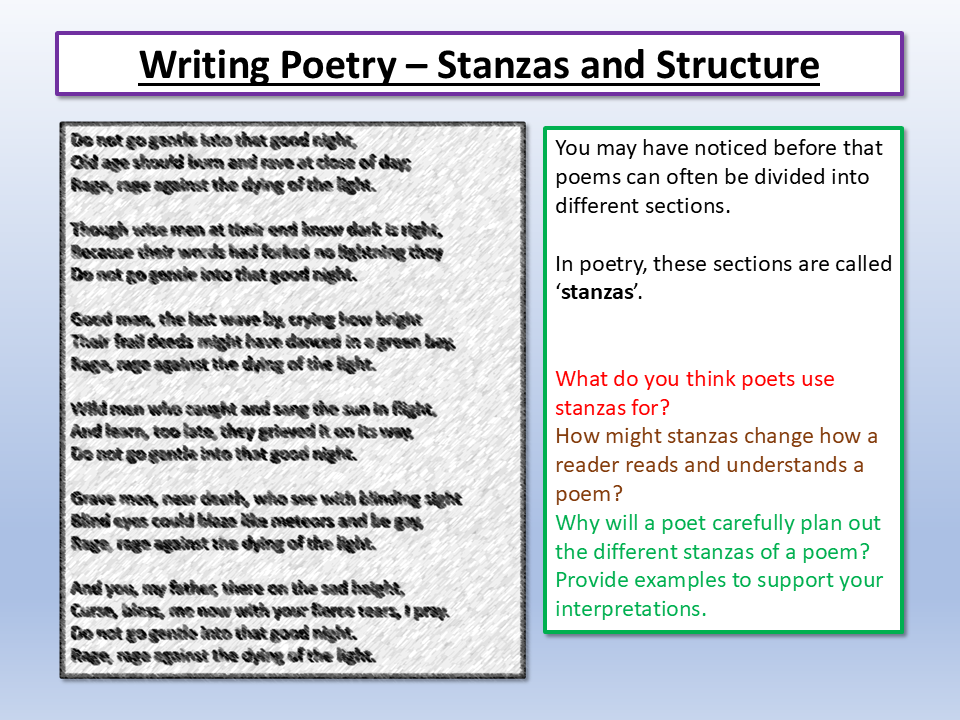


Poetry writing lesson for KS3 students that focuses on stanzas and structure: exploring how a writer divides up their poem into different sections and why, as well as the impact of refrains on the reader. We use the example of Do not go gentle into that good night by Dylan Thomas, before moving on to creating our own poems featuring these structure/structural devices.
Students create their own short poems on a childhood memory, using the multiple model examples provided in the lesson to help them use the structure devices effectively.
Together we explore the use of structural devices and how they convey the writer’s thoughts and feelings to the reader, including the effects they can have on a reader.
Students use these examples, to create their own short poems. The resource includes differentiated/adaptive learning strategies to ensure all students are making excellent progress.
Poetry writing is a creative and engaging way to help students understand and analyse poetry, which is so essential for GCSE English Literature study and exams.
This lesson will be part of a full unit on writing poetry that will explore language, structure, form, effects, imagery, messages and more.
**Have a query or question? Get in touch at info@englishgcse.co.uk **
Available as part of a Poetry Writing KS3 Complete Teaching Pack:

Poetry writing lesson for KS3 students that focuses on stanzas and structure: exploring how a writer divides up their poem into different sections and why, as well as the impact of refrains on the reader. We use the example of Do not go gentle into that good night by Dylan Thomas, before moving on to creating our own poems featuring these structure/structural devices.
Students create their own short poems on a childhood memory, using the multiple model examples provided in the lesson to help them use the structure devices effectively.
Together we explore the use of structural devices and how they convey the writer’s thoughts and feelings to the reader, including the effects they can have on a reader.
Students use these examples, to create their own short poems. The resource includes differentiated/adaptive learning strategies to ensure all students are making excellent progress.
Poetry writing is a creative and engaging way to help students understand and analyse poetry, which is so essential for GCSE English Literature study and exams.
This lesson will be part of a full unit on writing poetry that will explore language, structure, form, effects, imagery, messages and more.
**Have a query or question? Get in touch at info@englishgcse.co.uk **
Available as part of a Poetry Writing KS3 Complete Teaching Pack:
Related Products